KeBond™ PCP Performance Success Manitoba
Project Profiles
Project Information
| Client Name: | Confidential |
| Location: | Virden, Manitoba, Canada |
| Application: | Corrosion |
| Initial Install Date: | November 6, 2024 |
| Product: | 1 in ND KeBond™ Coated Endless Rod (ER) |
Client Challenge
In this historically corrosive production environment, maintaining reliable rod string performance has been a persistent challenge. Field economics were drastically affected by corrosion-related damage, resulting in significant downtime, frequent workovers, and escalating lifting costs. This case study highlights how KeBond coated continuous rod was deployed to break that cycle across both RRP-to-PCP conversions and new well completions.
A broad historical review across hundreds of wells showed multiple, compounding failure mechanisms: aggressive rod corrosion and pitting, sand and scale accumulation, rod parting, and tubing failures. Among these, corrosion and pitting on the rod surface were the dominant drivers – weakening the string, accelerating wear, and frequently culminating in rod parts and extensive repair costs. The opportunity was clear: if corrosion could be controlled at the rod string level, the client would extend runlife, reduce failure frequency, and materially lower lifting costs by cutting workover frequency and protecting downhole equipment from corrosion-initiated fatigue.
Application Details
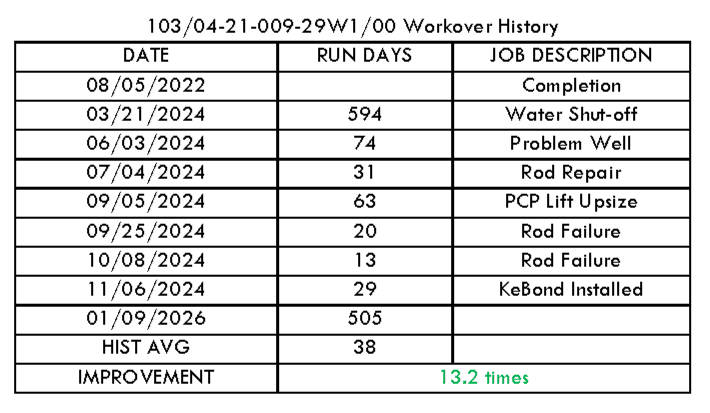
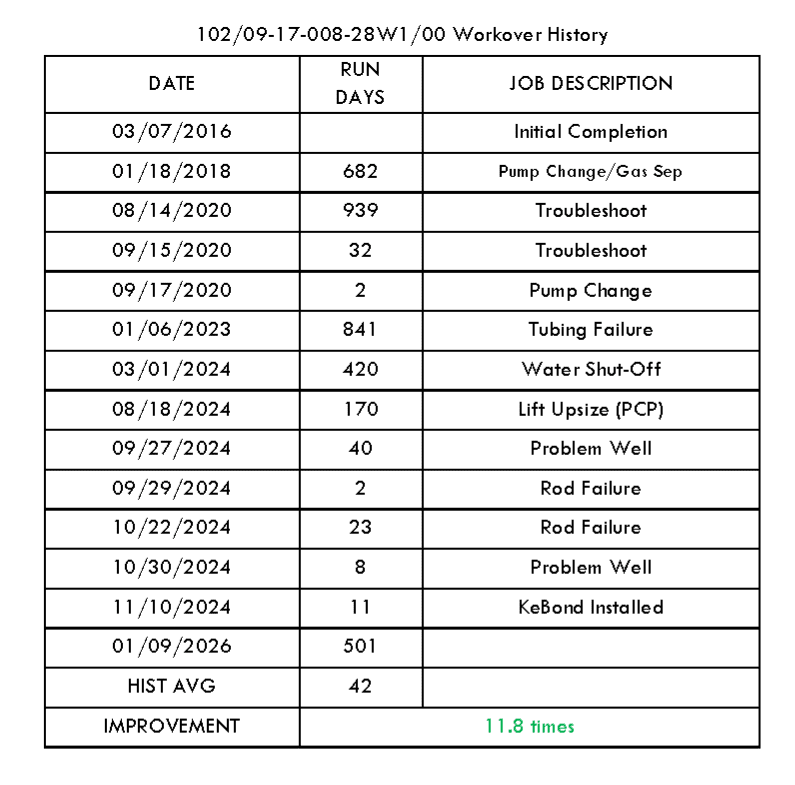
Three initial applications were selected based on high failure/workover frequency related to the client challenges. To address these persistent failures, many rod-related, switching from Reciprocating Rod Pump (RRP) to Progressing Cavity Pump (PCP) was implemented as a solution to reduce chronic rod pump failures, reduce the frequency of rod-related failures, and improve reliability in wells with high sand and scale production. Commentary from the historical workover documentation is included in quote.
“Laid down and junked entire rod string due to corrosion and pitting. Leave down waiting for PCP design.”
“Pulled our of hole with rods to find 75th rod parted. 22mm 1per spin thru’s in vertical, 3 per in deviated section.”
“Pulled our bottom hole pump assembly and rods. Some guide wear and corrosion in the middle of the string.”
Target bare rod material on the conversions was grade ND/NS in both 1in and 1-1/8in rod size, depending on target fluid rates and pump size selection. Utilization of AISI 4318 Nickel Chrome Molybdenum Alloy steel as the underlying base material to provide additional corrosion resistance under the KeBond barrier coating, once it becomes compromised by wear over time.
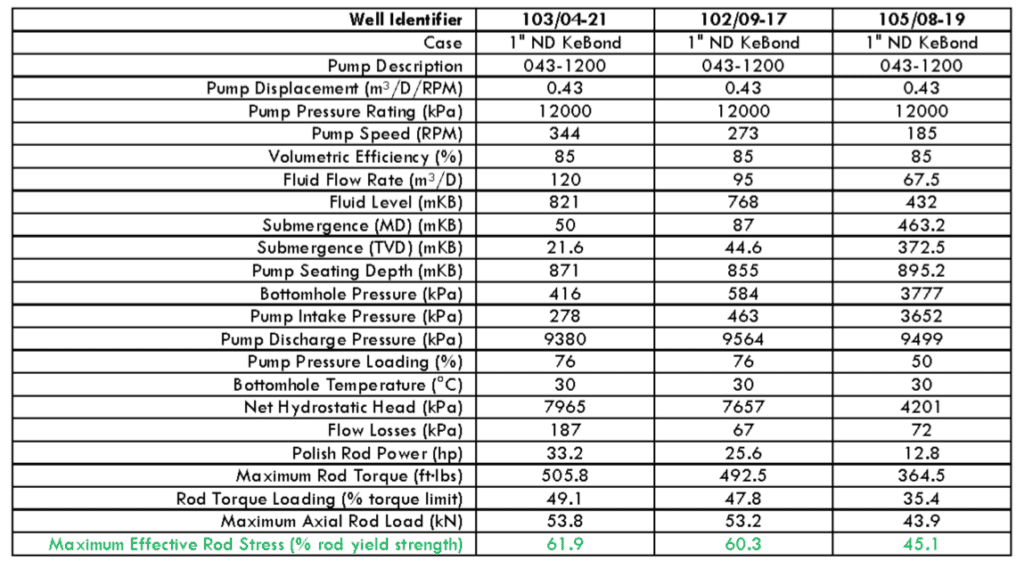
An application comparison summary is included on the initial 3 wells as outlined in Table 1 below. The maximum effective rod stress is low in each case, reiterating that rod fatigue issues are likely related to corrosion-initiated fatigue.
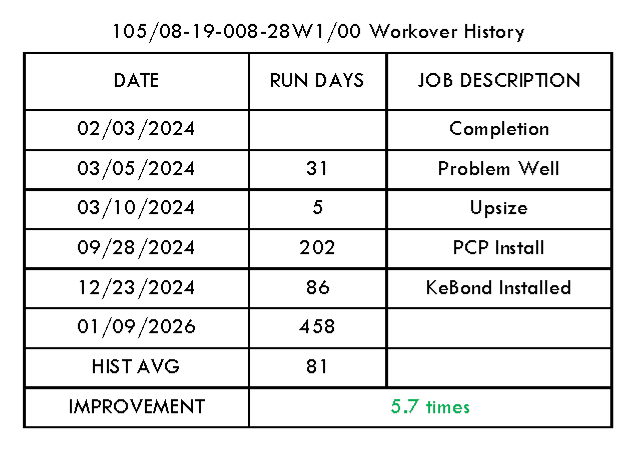
Rod String History
Conclusion
Since the initial installation in November 2024, field installations have expanded to 41 rod strings, split between RRP-to-PCP conversions and new well completions. Across these deployments, the KeBond barrier coating has effectively isolated the base metal from corrosive produced fluids, eliminating the rod string corrosion and pitting that historically drove premature failures and rod parting. By preventing corrosion at the rod surface and maintaining a more stable operating condition, KeBond has reduced intervention frequency, extended runlife, and improved overall reliability in this historically corrosive area. Based on the performance observed to date, expanding KeBond use in similar corrosive PCP applications is recommended, with continued monitoring and inspections to further quantify long-term corrosion elimination and lifecycle cost benefits.
Let’s solve your lift challenges.
Reach out and Experience Performance with Lifting Solutions.