TAPERAL™ PC Pump Field Success
Project Profiles
Project Information
| Client Name: | Confidential |
| Location: | Smith, Alberta, Canada |
| Field Application: | Clearwater Formation, Foamy Oil |
| Evaluation Period: | March 2026 |
| LS Products and Services: | TaperAL™ PC Pump |
Client Challenge
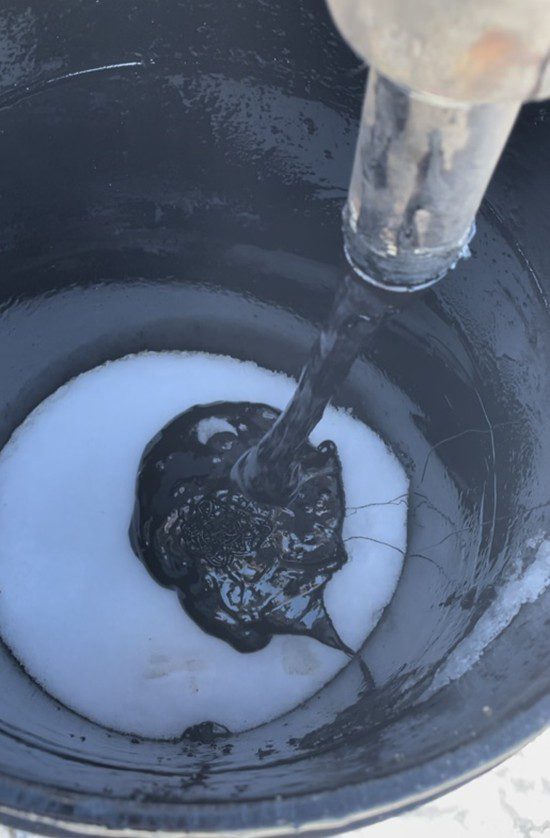
Undersaturated reservoirs are common in Canadian heavy oil operations, where produced fluids consist of oil, dissolved solution gas, and water under pressure. In Cold Heavy Oil Production with Sand (CHOPS), reducing reservoir pressure below the bubble point induces gas exsolution and expansion, which serves as a primary drive mechanism to mobilize oil toward the wellbore. However, this process often results in the generation of free gas and foamy flow behavior, particularly under aggressive drawdown conditions.
As gas volume increases, it occupies a larger fraction of the produced fluid, reducing effective liquid fill within progressing cavity pump (PCP) cavities and negatively impacting volumetric efficiency. Additionally, gas breakout in the form of foam reduces fluid lubricity and heat transfer capacity, accelerating stator elastomer degradation and increasing the likelihood of premature pump failure.
To sustain production, operators frequently deploy larger pumps at reduced rotational speeds to accommodate gas interference. While this approach can maintain throughput, it increases torque requirements and places additional mechanical strain on the rod string and surface equipment. Downhole gas separators may partially mitigate gas ingestion; however, their effectiveness is often limited in wells with constrained casing geometries, high production rates, or elevated fluid viscosities.
These operational challenges commonly result in high workover frequency, increased maintenance costs, and reduced overall field profitability.
Application Details
This application encompasses 81 actively producing horizontal multilateral wells targeting heavy, foamy oil from the Clearwater Formation, completed in 177.8 mm (7″) casing.
Field-wide production variable ranges are listed in the table below:
| Parameter | Minimum | Maximum |
| Production (m3/d) | 5 m3/d | 40 m3/d |
| Gas/Oil Ratio (m3/m3) | 163 m3/m3 | 350 m3/m3 |
| BS&W (%) | 0% | 60% |
| Dead Oil Viscosity (cp) | 1,200 cp | 6,000 cp |
| Oil API Gravity (º) | 11º | 17º |
A combination of downhole gas management technologies is deployed across the field, including the Lifting Solutions GasAL™ gas separator, which is intended to reduce free gas at the PCP intake and is run with both conventional PCP systems and the TaperAL PCP. While GasAL provides excellent reduction of intake gas, it is highly dependent on emulsion viscosity and production rates. Several wells from the larger sample set continue to operate with elevated gas volume fraction (GVF) at the pump inlet, indicating limited separator effectiveness under certain conditions. In these applications, the TaperAL PCP is not intended to replace or even affect gas separation, but rather to improve pump durability by redistributing pressure more uniformly along the pump stages, thereby reducing localized loading and extending runlife in the presence of free gas.
Client Goals
The client’s objective was to mitigate the adverse effects of high GVF fluid entering the pump intake and damaging stator elastomers, thereby improving PCP runtime and reducing workover frequency. This is specially important in applications where free gas is entrained in foamy emulsions and cannot be effectively separated from the higher viscosity oils at the required rates.
Success was defined by a meaningful reduction in workover frequency and associated operating costs, along with improved pump runtime under comparable operating conditions. Achieving these outcomes would enhance overall field performance and economic sustainability.
LS Solution
To address these challenges, the Lifting Solutions Engineering and Technical teams implemented the TaperAL progressing cavity pump (PCP) across the field.
The TaperAL PCP incorporates a tapered stator geometry, featuring higher interference (compression) at the intake and reduced interference at the discharge, while utilizing a conventional rotor. This design promotes more uniform pressure distribution along the pump length by reducing localized loading.
C28 Rotor with Standard Stator/Core
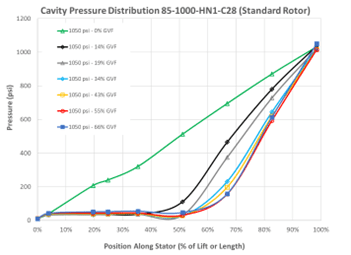
C28 Rotor with Tapered Stator/Core
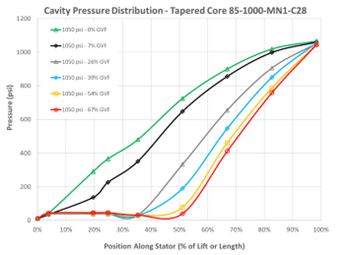
C12 Rotor with Tapered Stator/Core
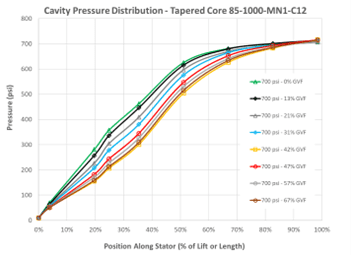
***Pressure distribution will shift LEFT (with looser fit, lower viscosity) shift RIGHT (with tighter fit, higher viscosity)
In high GVF conditions, conventional PCPs tend to concentrate the majority of gas recompression work at the discharge end, leading to localized thermal and mechanical stress. The TaperAL design mitigates this effect by redistributing the workload more evenly, reducing peak stress and delaying elastomer degradation. This results in improved durability, extended runtimes, and reduced likelihood of premature failure.
Following initial field trials, the client expanded deployment to 59 TaperAL PCPs across 81 wells, representing a significant field-wide implementation.
Workover Trends and Cost Reduction
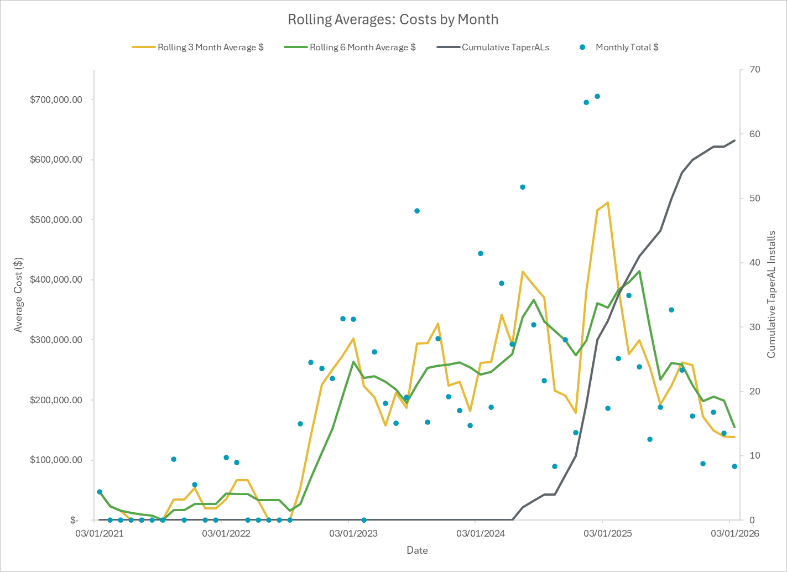
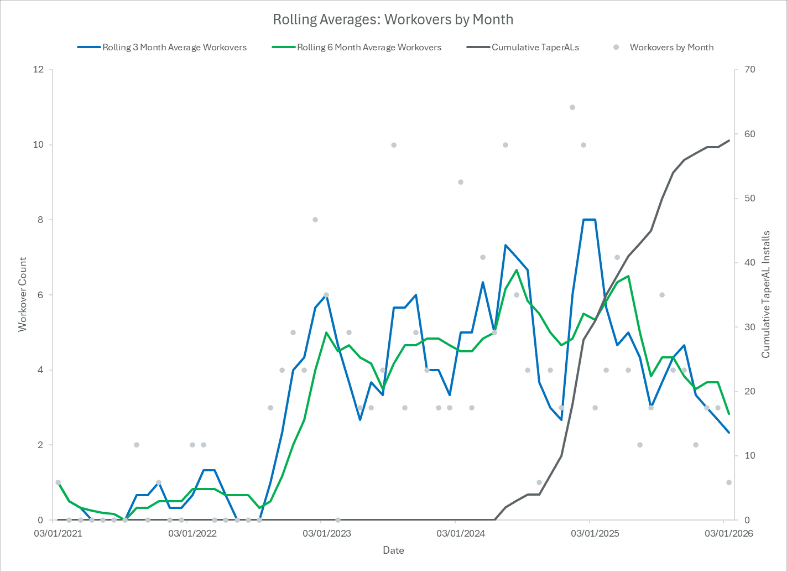
Rolling 3-month and 6-month averages were used to evaluate trends in workover frequency and associated costs relative to cumulative TaperAL installations. Rolling averages reduce short-term variability and highlight underlying operational trends. Following the TaperAL rollout, both workover frequency and associated costs demonstrated a clear stabilization trend. Previously increasing workover activity flattened and began to decline as the number of installed TaperAL PCPs increased.
Normalized Performance Metrics
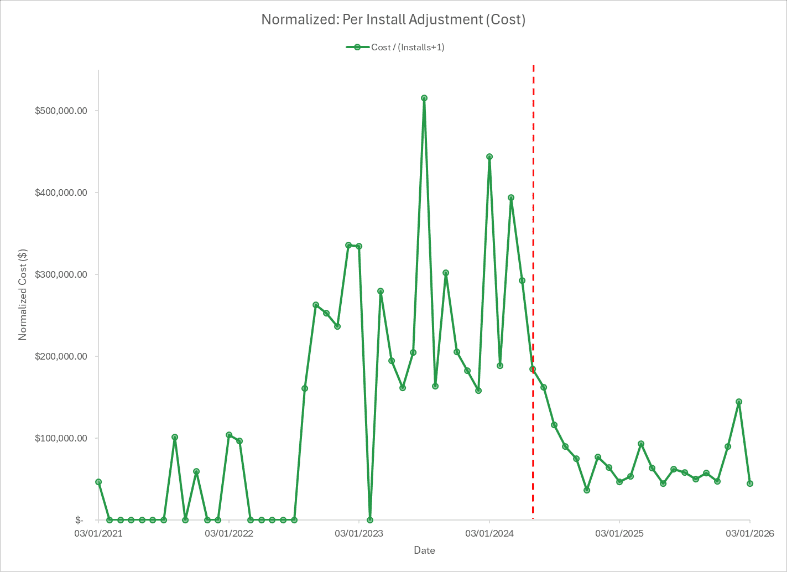
To further assess performance, workover frequency and cost data were normalized relative to the number of TaperAL installations. This normalization accounts for the rate of deployment and provides a per-installation performance metric. The analysis demonstrated that each incremental TaperAL installation corresponded to a substantial reduction in workover burden and associated costs. Specifically, workovers per installation decreased by approximately 49%, while cost per installation decreased by approximately 44%.
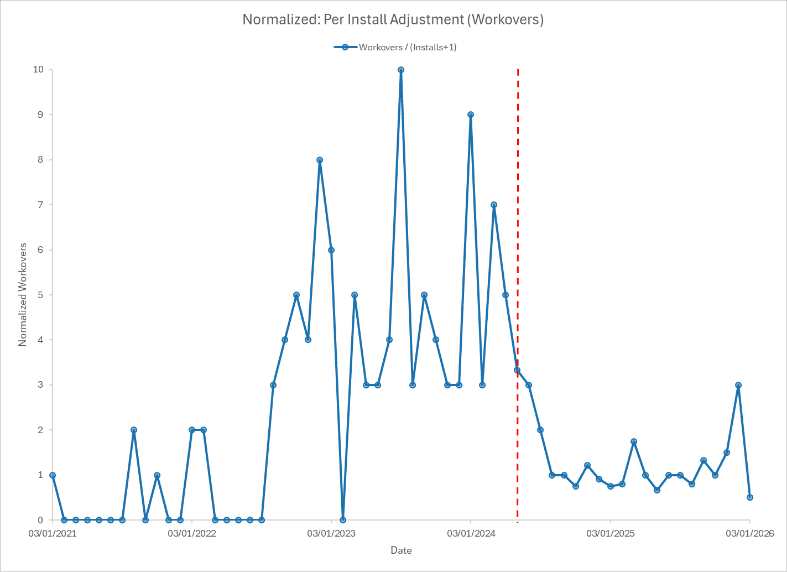
Cumulative System Impact
When evaluated on a cumulative basis, the long-term system impact became more pronounced. Workovers per cumulative installation decreased by approximately 84%, while cost per cumulative installation decreased by approximately 83%. These results indicate that as TaperAL deployment increases across the field, the residual workover burden per installed system continues to decline significantly, demonstrating strong scalability of the solution.
Operational Stability
In addition to reducing total workover frequency, the TaperAL implementation improved operational stability across the field. This was quantified using the coefficient of variation, which measures variability relative to the mean. Post-deployment analysis showed a reduction of approximately 40% in workover variability and approximately 35% in cost variability. This improvement indicates a reduction in extreme operational events and more predictable system performance, enabling improved planning and resource allocation.
Summary of Key Performance Improvements
| Metric | Improvement |
| Workovers per Install | ↓ 49% |
| Cost per Install | ↓ 44% |
| Workovers per Cumulative Install | ↓ 84% |
| Cost per Cumulative Install | ↓ 83% |
| Relative Volatility | ↓ 35 – 40% |
Conclusion
Through close collaboration with the client, the Lifting Solutions Engineering and Technical teams successfully implemented a field-wide solution to mitigate PCP failures associated with high gas volume fraction conditions. Deployment of the TaperAL PCP resulted in substantial improvements in pump reliability and field performance.
The technology delivered significant reductions in workover frequency and associated operating costs on a per-installation basis, while also demonstrating strong cumulative system benefits as field-wide deployment increased. Operational stability improved markedly, with reduced variability in both workover frequency and cost, contributing to more predictable field performance.
Before the implementation of the TaperAL PCP, conventional PCP systems in this field exhibited high failure rates and associated workover costs, negatively impacting overall field economics. the introduction of TaperAL technology has materially improved economic viability by reducing maintenance requirements, minimizing non-productive time, and lowering total operating costs.
Continued deployment and monitoring are expected to further enhance these benefits as field coverage increases and long-term performance data is accumulated.
Let’s solve your lift challenges.
Reach out and Experience Performance with Lifting Solutions.